Responding to Youth Violence through Youth Work by Seal Mike Harris Pete
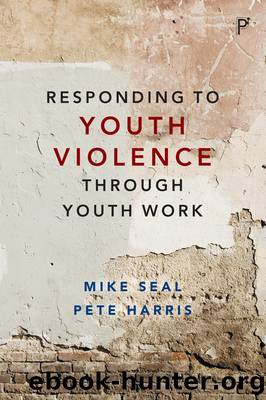
Author:Seal, Mike, Harris, Pete [Seal, Mike, Harris, Pete]
Language: eng
Format: epub
Tags: Social Science, Criminology, Social Work, Children's Studies
ISBN: 9781447323105
Google: PTjpDAAAQBAJ
Publisher: Policy Press
Published: 2016-09-14T04:14:41+00:00
Summary
Our interviews with young people and youth workers revealed that violence was an everyday occurrence. They felt that a loss of hope or any sense of control over the future was part of the aetiology of violence, and that this was leading to a nihilist world-view. In some cases, young people had lost any sense of the uniqueness and humanity of the others around them. Workers who were struggling to respond meaningfully to this violence felt their ability to do so was restricted by their own inertia and alienating work practices that constricted their relationships with young people and reduced their role to that of technocratic problem solver. However, both young people and workers were able to identify some key features of youth work practice that they felt had desistance-promoting potential, such as celebrating small symbolic achievements and finding new meaning within their life narratives.
An existentialist perspective on youth work and violence opens up the possibility of taking moments of individual crisis and decision seriously, something with significant implications for desistance. Our data indicates that young people, particularly at times of trauma or stress, often do ask existential questions around meaning and essence, that is, they are drawn through epiphanies and existential crises. Where youth workers are attuned to this, they can seek to enable young people to look beyond their past and the functional roles allocated to them by their communities or society.
We then outlined two alternative branches of existentialism: one Sartrean and the other Christian. We explain how these differ and might lead to subtle but significant different modalities of youth work practice in response to violence.
Both these existentialist perspectives can provide a sustaining framework for interpersonal and professional relationships to become possible in ways that young people with deeply nihilistic world-views might not otherwise expect. Youth workers who choose to maintain their faith in what young people may become can issue a challenge to that nihilism and violence. That said, they need to be wary of drifting into a form of didactic moralising that could further alienate young people well used to such approaches from adults and professionals.
This all serves to remind policymakers that professional development regimes that stress rational detachment, formulaic adherence to policy, vigilance around professional boundaries and practice drawn from prescribed repertoires need always to be balanced with an approach to young people that is delivered in the moment, drawn from the personal as well as professional self, and may more readily engender apprehension of the impact of oneâs actions on others. It also reminds us that youth work is different depending on who is delivering it, and brings the importance of authentic relationships to the fore.
Download
This site does not store any files on its server. We only index and link to content provided by other sites. Please contact the content providers to delete copyright contents if any and email us, we'll remove relevant links or contents immediately.
| Anthropology | Archaeology |
| Philosophy | Politics & Government |
| Social Sciences | Sociology |
| Women's Studies |
Cecilia; Or, Memoirs of an Heiress — Volume 1 by Fanny Burney(32538)
Cecilia; Or, Memoirs of an Heiress — Volume 2 by Fanny Burney(31935)
Cecilia; Or, Memoirs of an Heiress — Volume 3 by Fanny Burney(31925)
The Great Music City by Andrea Baker(31911)
We're Going to Need More Wine by Gabrielle Union(19032)
All the Missing Girls by Megan Miranda(15925)
Pimp by Iceberg Slim(14476)
Bombshells: Glamour Girls of a Lifetime by Sullivan Steve(14046)
For the Love of Europe by Rick Steves(13868)
Talking to Strangers by Malcolm Gladwell(13341)
Norse Mythology by Gaiman Neil(13332)
Fifty Shades Freed by E L James(13228)
Mindhunter: Inside the FBI's Elite Serial Crime Unit by John E. Douglas & Mark Olshaker(9313)
Crazy Rich Asians by Kevin Kwan(9271)
The Lost Art of Listening by Michael P. Nichols(7487)
Enlightenment Now: The Case for Reason, Science, Humanism, and Progress by Steven Pinker(7303)
The Four Agreements by Don Miguel Ruiz(6739)
Bad Blood by John Carreyrou(6609)
Weapons of Math Destruction by Cathy O'Neil(6260)
